 Written by
 ChatGPT
 Claude
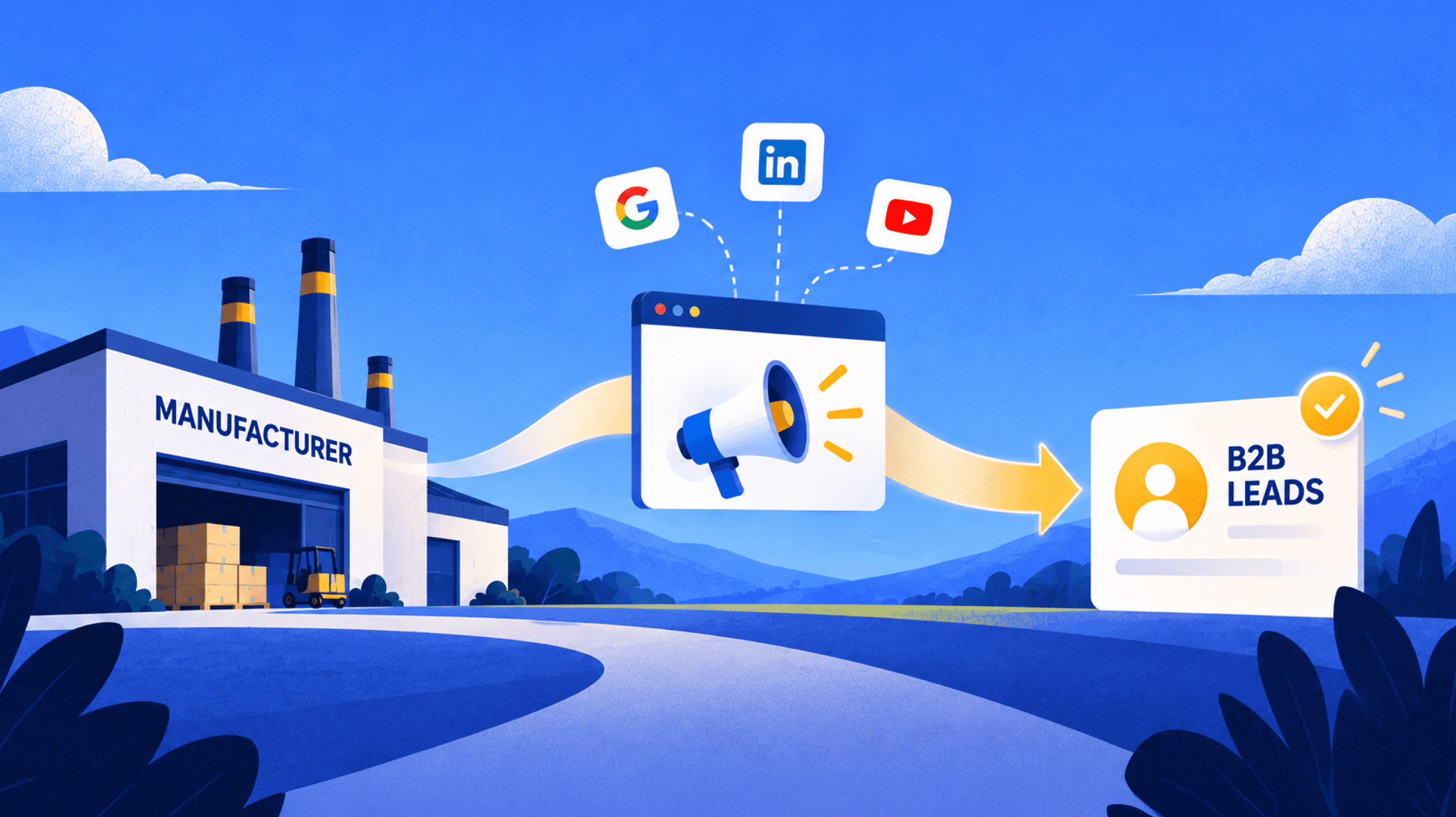
Manufacturers generate B2B leads online by making their expertise easy to find and easy to act on. That usually means search optimization built around part numbers and technical specifications, a website designed to capture requests for quote (RFQs), account-based marketing for long buying cycles, and technical content structured so both people and AI tools can understand it.
Why are manufacturers losing RFQs they never knew existed?
Because buyers build their supplier shortlist online before they contact anyone. If your company isn’t found during that early research, it is ruled out before a request for a quote is ever sent.
Trade shows, distributor relationships, and outbound calls still matter, but most buying journeys no longer start there.
Engineers and procurement teams now start by searching online, comparing capabilities, and building a shortlist before they ever contact a supplier. A CEB and Google study, based on 2012 survey data, found that B2B buyers were about 57 percent of the way through their purchase decision before they contacted a supplier’s sales team.
Industrial categories vary, but the direction is clear. If your company is not visible and credible during early research, you may never be invited to quote.
Digital marketing gives manufacturers a measurable way to show up in that moment. Every search, page visit, download, and quote request can be tracked, which helps teams see what is working and adjust their plan.
How do industrial buyers research suppliers?
Buyers rarely rely on one source. Most draw from several touchpoints before they ever contact a supplier. The most common include:
- Search engines: Engineers search for a specific capability, material, or part number.
- Industry directories and trade sources: Procurement teams use trusted B2B directories and association listings to verify suppliers.
- AI assistants: Buyers increasingly ask tools such as ChatGPT, Gemini, Perplexity, or Google AI Overviews to summarize options or suggest suppliers.
- Trade shows and industry events: Buyers meet suppliers in person, see products firsthand, and compare capabilities side by side.
- Peer recommendations and word of mouth: Colleagues and industry contacts often influence who makes the shortlist.
- Industry publications and trade magazines: Technical articles and supplier features build awareness and credibility.
- Online forums and professional communities: Engineers ask for supplier advice and share experiences on LinkedIn groups, Reddit, and technical forums.
- Review platforms: Ratings and customer feedback help buyers judge reliability before they reach out.
- Paid advertising: Search and LinkedIn ads put a supplier in front of buyers who are actively looking.
Your company information needs to be clear and consistent across every one of these touchpoints. Buyers often see your name in several places before they decide to contact you, and mixed or outdated details can cost you trust.
How does industrial SEO help manufacturers get found?
Industrial SEO differs from consumer SEO. The phrases that matter are often part numbers, material grades, tolerances, and OEM terms rather than broad category words.
A buyer searching “17-4 PH stainless CNC machining tolerance .0005” is likely much closer to requesting a quote than someone searching “custom metal parts.” Because these searches are so specific, they tend to attract visitors who already know what they need.
To build around these searches, focus on three things:
- Publish structured technical data: Put material grades, tolerance classes, equipment capacity, and certifications on capability pages, ideally in tables that match how engineers compare suppliers.
- Name the exact process and material in the headline. A page titled “5-Axis CNC Machining for Aerospace Titanium” tells both a buyer and a search engine far more than “Our Services.”
- Show proof. Include certifications, inspection equipment, and industries served so a visitor can confirm fit in a few seconds.
Paid search can complement organic rankings while your content builds authority. Because paid clicks come from people actively searching, many manufacturers use Google Ads to bring in pipeline early, then adjust the balance as organic results mature.
What makes a manufacturing website convert?
Strong traffic is wasted if the site creates friction. Most B2B websites see only a small share of visitors complete a form, so every unnecessary obstacle matters. Common problems include:
- File upload tools that reject standard CAD formats such as STEP, DXF, or DWG
- Long forms that ask about budget or revenue before the buyer has described the part
- No clear statement of when the buyer will hear back
- Capability pages that describe the company instead of confirming whether it can do the job
A practical RFQ form has about five fields: name, email, company, part description, and drawing upload. We recommend keeping it that short and letting buyers attach files right away.
Response speed matters too. A 2007 study by MIT researcher James Oldroyd and InsideSales.com found that the odds of qualifying a lead were about 21 times higher when a company responded within five minutes instead of 30 minutes. The study covered six companies, so treat it as a guide rather than a guarantee.
The lesson still holds: a good form is half the process, and fast follow-up is the other half.
How do technical content, CAD files, and video generate leads?
Engineers value substance. Spec sheets, CAD models, compliance documents, and process videos give them reasons to trust a supplier.
A simple balance works well. Keep overview specifications open to everyone. Place higher-value assets, such as complete CAD packages, detailed whitepapers, or compliance documentation, behind a short form. Buyers who request these assets usually have an active project, so those leads tend to be more relevant. Gating everything, however, frustrates the same engineers you want to win.
Video can help as well. Short machining demonstrations, quality inspection walkthroughs, and facility tours let buyers see your capability instead of reading about it. Add transcripts and clear descriptions so search engines and AI tools can understand the content too.
How does account-based marketing work for manufacturers?
Manufacturing sales cycles are often long, commonly spanning many months, and purchase decisions usually involve several stakeholders. Account-based marketing (ABM) focuses marketing and sales effort on a defined list of target accounts instead of a broad audience.
ITSMA research from 2023 found that 76 percent of marketers get a higher return from ABM than from any other form of marketing, though results depend on how well a program is run.
In practice, ABM means building a different nurture path for each person on the buying committee:
| Stakeholder | Primary concern | Content that helps |
|---|---|---|
| Procurement director | Cost, lead time, supply reliability | Pricing structure, capacity data, on-time delivery history |
| Design engineer | Material performance, tolerance capability | Spec sheets, tolerance charts, testing and validation data |
| Quality/compliance lead | Certifications, traceability | ISO documentation, compliance records, audit history |
| Plant/operations leader | Integration risk, ramp-up time | Case studies, implementation timelines, support process |
This approach helps avoid a common problem: winning over an engineer while procurement never receives a single relevant message.
Which channels support ABM and lead nurturing?
LinkedIn is a natural fit because it lets you target by company, job title, and industry. Email supports longer nurture sequences with technical resources, case studies, and updates.
Combine both with retargeting and personal outreach from your sales team so each stakeholder sees consistent messaging. Measure success at the account level, such as how many people from a target company engage, rather than looking only at individual clicks.
How is AI search changing supplier research?
Generative AI tools now answer questions that buyers used to type into a search bar.
In 2024, Gartner predicted that traditional search engine volume would fall 25 percent by 2026 as people turn to AI chatbots and virtual agents. Whatever the final figure turns out to be, buyer behavior is clearly shifting toward conversational research.
Generative engine optimization (GEO), sometimes called AI optimization or AIO, is the practice of making your content easy for AI systems to find, understand, and represent accurately.
No one can guarantee that an AI tool will mention a specific company. What manufacturers can do is improve visibility, clarity, and accuracy so their information is a reliable source.
What are the practical GEO steps for manufacturers?
- Publish clear technical data. Share tolerances, materials, and certifications in formats that people and crawlers can both read easily.
- Keep specifications consistent. If one page lists a tolerance that another page contradicts, both people and AI tools have less reason to trust either.
- Write question-based headings. Phrase headings the way engineers actually ask, such as “What are your machining tolerances for titanium parts?”
- Lead with the answer. Start each section with a short, direct response, then add detail.
- Keep proof current. Update case studies, certifications, and capability pages regularly.
- Keep your site accessible. Fast pages, clean structure, and crawlable content make it easier for search and AI systems to read your site.
The same pages that serve engineers well, with tolerance tables, material data, and documented certifications, also give AI tools dependable information to draw from.
How should distributor and OEM marketing differ?
Generic B2B playbooks often fall short in manufacturing because technical buyers notice vague content immediately. The distributor and OEM sides of a business also need different messages.
Distributors care about margin, inventory support, and co-marketing resources they can share with their own customers. OEMs care about direct engineering collaboration, custom specification support, and long-term supply reliability.
Treating both audiences the same usually underperforms with each. Build separate landing pages, resources, and calls to action. For distributors, that might be a partner portal and co-branded assets. For OEMs, it might be an engineering consultation and design-for-manufacturability guides.
How does SPINX Digital approach manufacturing marketing?
SPINX Digital is a Los Angeles digital marketing agency that works with manufacturers across the United States. We connect industrial SEO, website design focused on RFQ conversion, account-based strategy, and AI search visibility into one plan instead of separate projects.
This matters because each piece depends on the others. A ranking that brings an engineer to a capability page only pays off if the page captures the quote request, presents accurate specifications, and feeds a nurture path when procurement joins the evaluation. We tie our work to measurable outcomes, such as qualified RFQ volume and pipeline, instead of reporting traffic alone.
Conclusion
Manufacturers no longer depend on trade shows and cold calls alone. Buyers research online first, through search engines, industrial directories, and increasingly AI assistants, and they form opinions before they contact anyone.
The companies that benefit most build marketing around how industrial buyers actually behave. That means technical SEO built on real specifications, a website designed for RFQ conversion, account-based marketing for large buying committees, and clear content that AI tools can represent accurately. When these efforts work together as one system, every visit has a better chance of becoming a conversation.
Ready to build a stronger B2B lead pipeline?
If your team wants more qualified RFQs from engineers and procurement leaders, SPINX Digital can help.
Contact SPINX Digital today to schedule a free consultation and learn how an integrated SEO, website design, ABM, and AI visibility plan can fit your manufacturing business.


